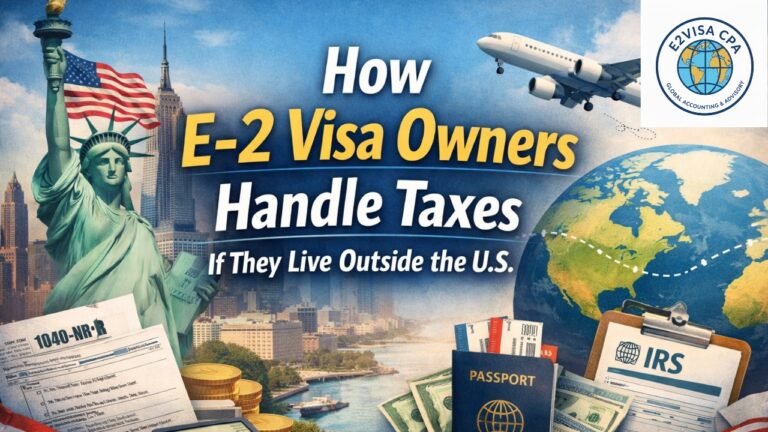
Many entrepreneurs operate businesses in the United States through an E-2 Visa, but not all of them live in the country full-time. Some investors manage their U.S. companies remotely while residing abroad.
Even if you live outside the U.S., your business activities may still create tax obligations with the Internal Revenue Service (IRS). Understanding how taxation works in this situation is essential to stay compliant and avoid penalties.
This guide explains how E-2 visa owners handle taxes while living outside the United States.
Do E-2 Visa Owners Have to Pay U.S. Taxes if They Live Abroad?
Yes, in many cases they do.
If you own or operate a U.S.-based business under an E-2 visa, the income generated in the United States is generally subject to U.S. taxation, even if you live in another country.
However, the exact tax obligations depend on several factors, including:
- Your tax residency status
- The structure of your U.S. business
- Whether you receive salary or distributions
- Applicable tax treaties between the U.S. and your home country
Understanding U.S. Tax Residency Rules
One of the most important factors affecting taxes is whether you are considered a U.S. tax resident or a nonresident alien.
The Internal Revenue Service determines tax residency primarily through the Substantial Presence Test.
You may be considered a U.S. tax resident if:
- You spend 183 days or more in the U.S. during a specific calculation period
- Your time spent in the U.S. across multiple years meets the IRS formula
If you are not a U.S. tax resident, you may be taxed only on U.S.-source income, such as:
- Profits from your U.S. business
- Salary from your U.S. company
- Rental income from U.S. property
Tax Obligations for E-2 Visa Owners Living Abroad
Even when living outside the U.S., E-2 visa entrepreneurs may still need to file several tax forms.
1. Federal Income Tax Returns
If your business generates U.S. income, you may need to file:
- Form 1040-NR – for nonresident individuals
- Form 1120 – for corporations
- Form 1065 – for partnerships
The correct filing depends on your business structure.
2. Business Taxes
Your U.S. company must file its own tax returns regardless of where you live.
Common business structures include:
- LLC
- S Corporation
- C Corporation
Each structure has different tax rules and filing requirements.
3. Payroll Taxes
If your U.S. business has employees, you must still comply with payroll tax obligations such as:
- Withholding federal taxes
- Social Security and Medicare contributions
- Filing employment tax forms
These obligations apply even if the business owner lives overseas.
4. State Taxes
Some states require businesses to file state tax returns if they operate within the state.
For example, companies operating in states like California or New York often face additional state-level tax filing requirements.
Avoiding Double Taxation
Many E-2 visa investors worry about being taxed in both their home country and the U.S.
Fortunately, the United States has tax treaties with many countries to reduce double taxation. These treaties may:
- Lower withholding tax rates
- Provide tax credits
- Define which country has primary taxing rights
Consulting a tax professional familiar with international tax rules is important to apply treaty benefits correctly.
Tax Planning Tips for E-2 Visa Owners Living Abroad
Maintain Proper Financial Records
Keep detailed records of:
- Business income
- Expenses
- Payroll
- International transactions
Choose the Right Business Structure
Different structures have different tax implications. In some cases, restructuring your business may improve tax efficiency. Choosing the appropriate entity type such as an LLC, S Corporation, or C Corporation can affect how profits are taxed and reported. Reviewing your business structure with a tax professional can help ensure it aligns with both your operational goals and U.S. tax regulations.
Work With a CPA Experienced in International Tax
Cross-border taxation can be complex. A CPA experienced with E-2 visa businesses can help ensure:
- Accurate filings
- Compliance with IRS rules
- Proper use of tax treaties
Why Professional Tax Guidance Matters
Managing a U.S. business while living abroad involves navigating multiple tax systems and regulations. Missing filings or misunderstanding residency rules can result in penalties or compliance issues.
Working with professionals who understand both E-2 visa business structures and international taxation can help protect your investment and ensure your business stays compliant.